State parks are where most drone pilots actually want to fly: the coastline, the canyon, the waterfall, the forest trail — the places that look best from the air. And the answer is: it depends on the state. There is no federal ban on drones in state parks, which is the first thing to understand, because the national park ban does not apply here. But there is also no federal permission. Each state writes its own rule, each park can add its own posted order, and the rule can change between two parks in the same state. This guide gives you the shape of the rules, the states that allow it, the states that require a permit, and the states that mostly say no — and the check you run before every flight, because the table below is a snapshot, not a licence.
One thing does not change by state: the FAA rules follow you everywhere. A drone over 250 grams must be registered, recreational pilots need the free TRUST certificate, flights stay below 400 feet and within visual line of sight, and controlled airspace needs LAANC authorisation. A state park that allows drones does not waive any of that — it only decides whether you may take off and land on its land.
The Short Answer: It Depends on the State
There is no single American rule for drones in state parks. In some states you can fly in most state parks without asking anyone. In others you need a written permit, and in a few the answer is effectively no. The reason is ownership: state parks belong to the state, and the state agency that runs them sets the land-use rules — which is a different power from the FAA’s control of the airspace. A city or a state cannot regulate the sky, but it can absolutely decide who takes off and lands on its ground, and that is the power that matters for a pilot standing in a car park with a drone.
The practical rule is simple: check the state, then check the park. The state rule tells you whether permission is possible; the park’s posted orders tell you whether it is possible today, at this park. A park can ban drones for a nesting season, a fire risk, or a crowded weekend even in a state that generally allows them, and a ranger can ask you to land if the drone is disturbing visitors or wildlife, even where no order is posted. If you remember one sentence from this guide, make it this one: the state rule is the starting point, and the park’s own signs are the final word.
National Parks vs State Parks: The One Difference That Matters

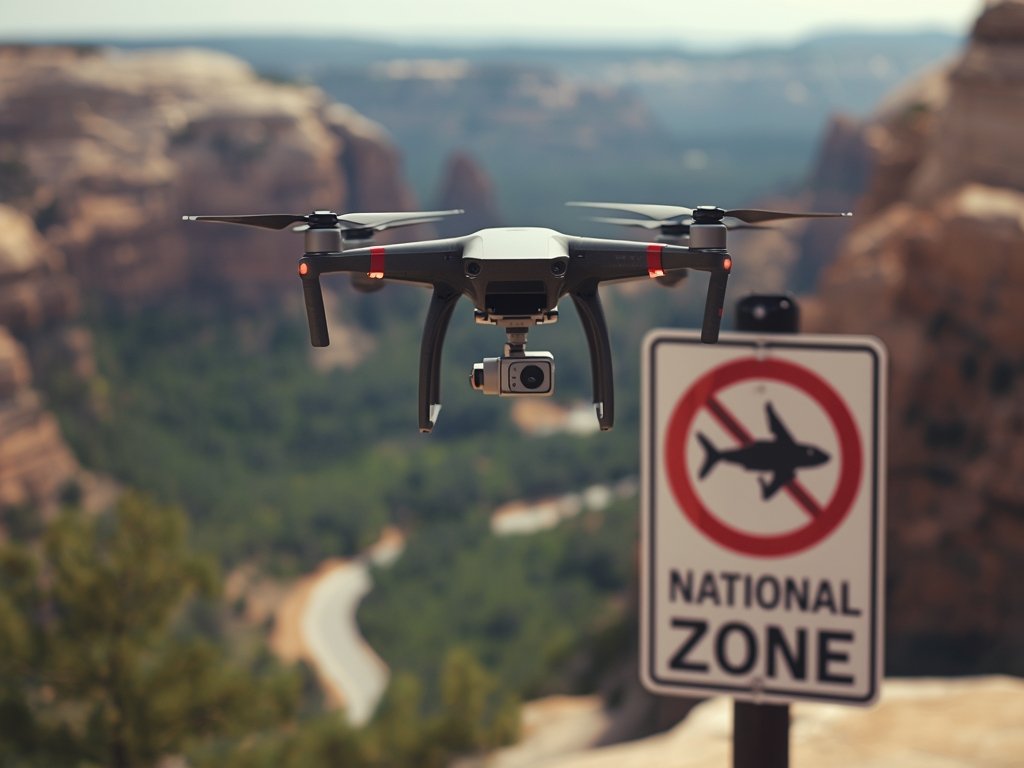
National parks are closed to drones by a federal ban. The National Park Service issued Policy Memorandum 14-05 in June 2014, using its closure authority under 36 CFR 1.5, and it prohibits launching, landing, or operating unmanned aircraft on park land — for recreational and commercial pilots alike, with only narrow exceptions for park business and permitted research. Our guide to flying a drone in a national park covers that ban in full, including the permit process and where to fly instead.
State parks have no equivalent federal ban, because they are not federal land. The FAA still controls the airspace above them, and the state controls the ground beneath them, and neither has issued a blanket prohibition. That is why the answer varies: it is fifty separate decisions, not one. It is also why the most common pilot mistake is assuming the national park rule applies everywhere — it does not, and pilots who assume it miss legal flying, while pilots who assume the opposite fly where they should not. Know which kind of park you are standing in before you launch.
The States That Allow It
California is the clearest example of a state that allows drones in its state parks. California State Parks says drones are currently allowed in state parks, state beaches, state historic parks, state recreational areas, and state vehicular recreation areas — except where prohibited by a District Superintendent’s posted order. The posted order is the catch: an individual park can ban drones to protect threatened species, cultural resources, or public safety, or because of high fire danger, and the ban is posted at the park. Wilderness areas, natural preserves, and cultural preserves inside the state park system are different again: state regulations prohibit motorised equipment there, including drones, so check the designation of the unit, not just the park’s name. Commercial flights in California state parks require a permit, even where recreational flights do not. The official page is at California State Parks: drones in state parks.
Other states are permissive in the same way, with the same caveat: allowed by default, banned where posted. The pattern to look for is a state parks agency that has published a drones page saying flights are allowed except where a superintendent has posted otherwise. If your state has published that, you are in the permissive group — and your job is to check the specific park’s orders before you go, because a permissive state still has parks with bans.
The States That Require a Permit
Several states allow drones in state parks only with written permission, and the permission takes time. Washington is the clearest case: Washington Administrative Code 352-32-130 says no aircraft may take off or land in a state park area except in an area specifically designated for it — and flying is allowed only on a one-time permission granted by the park director or their designee. That is not a formality: you apply, you wait, and you fly only where the permission says.
New Jersey is similar: the State Park Service prohibits drone take-off and landing unless prior permission has been granted by the Assistant Director. Hawaii requires a written permit from the Department of Land and Natural Resources for any drone use inside state park boundaries, under Hawaii Administrative Rules Chapter 13-146 — and the permit takes weeks, not days, so it is a planning exercise, not a same-day decision. Massachusetts treats a drone as an aircraft on Department of Conservation and Recreation land, and its parks regulation, 302 CMR 12.00, requires a Special Use Permit for take-off, landing, or operation on DCR property. Note that Massachusetts was actively redrafting that regulation in 2026, with public hearings posted on the state’s regulations page — the drone provisions could shift, so pull the current version from mass.gov before you plan a flight there. The common thread is lead time: a permit state is a state you plan for, not a state you improvise in.
The States That Mostly Say No
Texas is the hardest case for pilots who assume state parks are open. Texas Parks and Wildlife only allows drones in the designated area of Martin Dies, Jr. State Park, or at other parks with a filming permit from the park — which means that for practical purposes, most Texas state parks are closed to drones. A filming permit is a real process with a real lead time, and it is aimed at productions, not at a pilot with a camera drone on a Saturday.
The lesson is not that Texas is unusual — it is that “mostly no” states exist, and they are not always the ones you expect. Some states have no published drones policy at all, which is worse than a ban in one way: there is nothing to rely on, and the decision falls to the individual park superintendent or ranger. In a state with no published policy, call the park before you go and ask. A phone call is free, and a ranger’s answer on the day is the only rule that counts. And remember that the absence of a sign is not permission: a park that has never posted a drone order can still ask you to land, and a pilot who argues about the sign is a pilot who gets remembered.
How to Check Before You Launch
Run this check before every state park flight, in this order. First, the state: search for the state parks agency’s drones page — “[state] state parks drone policy” — and read what it actually says, not what a blog says it says. Second, the park: check the park’s own page and its posted orders for a drone ban, a seasonal closure, or a permit requirement. Third, the airspace: open B4UFLY or your LAANC app and check for controlled airspace, temporary flight restrictions, and nearby airports. A state park next to an airport can be legal on the ground and restricted in the air, and the airspace check is the one that catches it. Our guide to checking airspace before you fly covers that step in full.
Fourth, the day itself: check for fire restrictions, nesting closures, and events. A park that allows drones on a quiet Tuesday can ban them during a fire-risk weekend or a festival, and the ban may be posted only at the gate. Fifth, the paperwork: if the state requires a permit, have it with you — on paper or on your phone — and fly only where it allows. And if any step in the check is unclear, call the park. Rangers would rather answer a question than write a citation, and a pilot who asked first is a pilot who gets the benefit of the doubt.
Commercial Flights: A Different Rule

Everything above is the recreational picture. Commercial flights — any flight that is part of a business, including photography you sell — face a second layer. In California, commercial drone operations inside a state park require a permit even where recreational flights are allowed. In permit states, the commercial permit is a separate process from the recreational one, and it usually takes longer. And everywhere, commercial flights need a Part 107 certificate, a registered drone, and Remote ID — the FAA’s commercial rules do not relax because the ground is a park.
The practical consequence is that a real-estate or mapping job in a state park is a two-permit job: the FAA’s Part 107 for the pilot, and the state’s permit for the land. Quote the job with the permit lead time built in, and do not promise a client a date until the permit is in hand. A client who learns on the day that the park said no is a client who does not come back.
What Happens If You Fly Without Permission

The consequences are smaller than the national park penalties, but they are real. A ranger can order you to land immediately, and refusing is a separate offence from flying. A citation for violating a state park regulation is typically a fine — the amount varies by state — and a repeat offence or a flight that disturbs wildlife, damages resources, or endangers visitors can be charged more seriously. In a state where the rule is a permit requirement, flying without the permit is the violation, whether or not anything went wrong.
The worse consequence is not the fine: it is the next ban. Parks that have trouble with drones post orders, and orders spread. Every pilot who flies where they should not makes the next pilot’s job harder, and the permissive states stay permissive only while pilots behave. The FAA’s own rules still apply on top of all of this — TRUST, registration, 400 feet, line of sight — and a pilot who breaks the state rule and the FAA rule at the same time has two problems, not one. Our guides to flying without registration and how high you can legally fly cover the federal side; the state side is the check in the section above.
Frequently Asked Questions
Can I fly a drone in a state park in California? Yes, in most units — California State Parks allows drones except where a District Superintendent has posted an order prohibiting them, and except in wilderness areas, natural preserves, and cultural preserves. Check the park’s orders first.
Do I need a permit for a state park? It depends on the state. Washington, New Jersey, Hawaii, and Massachusetts require written permission; California generally does not for recreational flights. Check the state parks agency’s drones page.
Can I fly over a state park if I launch from outside it? The FAA controls the airspace, and a state cannot ban overflight — but it can ban take-off and landing on its land, and a ranger can still ask you to land if the flight disturbs the park. Launching outside and flying in is a grey area, and the safe course is to treat the park’s rule as applying to the flight, not just the launch point.
What about city and county parks? Cities and counties cannot regulate airspace — that was settled in Singer v. City of Newton in 2017 — but they can control take-off and landing on their own property, and many do. Nashville, for example, prohibits drone flights in city parks except in three designated areas. Check the local rule, not just the FAA’s.
Join Our Pilot Community
Connect with fellow drone enthusiasts, share your aerial shots, and get access to free PDF ebook guides.