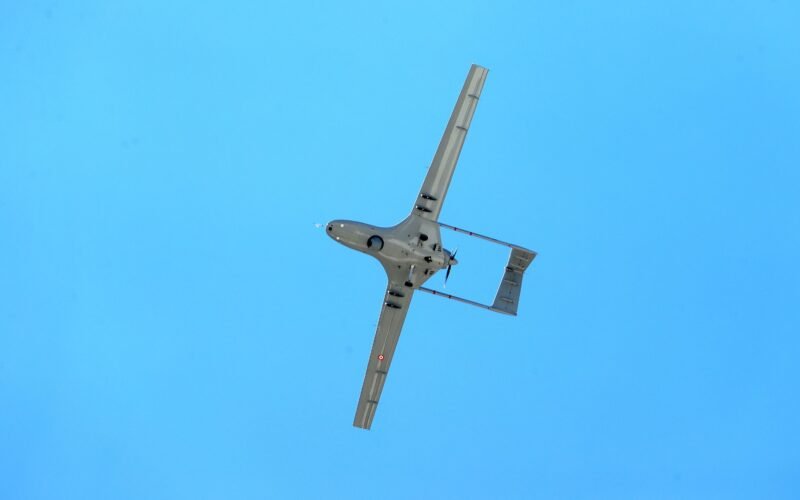
The Federal Aviation Administration is taking public comment on a draft environmental assessment that would let Zipline fly up to 130,000 drone deliveries a day over Arizona — 65,000 in the Phoenix metro area and 65,000 in Tucson, around the clock, holidays included. Zipline does not fly in Arizona yet, and the company told 12News in Phoenix this week that it hopes to start serving customers there in early 2027. The draft, published by the FAA in November, is the largest drone delivery proposal the agency has ever reviewed, and it is, by the FAA’s own comparison, 277 times the size of the only earlier drone delivery review in Arizona: Amazon’s Prime Air hub in Tolleson, approved in November 2024 for 469 flights a day. This article sets out the numbers in the draft, the deadlines for commenting, and the flaws in the document that its critics have already found — because the draft, as DroneXL reported, reads in places like a Texas document with the place names changed.
The proposal is a ceiling, not a forecast. Zipline’s community engagement lead, Zach Hill, told 12News that the company makes a delivery somewhere in the world every 15 seconds — 5,760 a day — and that the Arizona numbers are demand-based: the ceiling is there if the demand arrives, not because Zipline expects 130,000 deliveries on day one. But the ceiling is what the FAA is being asked to approve, and it is the ceiling that matters for the communities underneath. A draft that authorises 390,000 drone flights a day over two cities is a different proposition from a pilot project, and the public comment period now under way is the moment for residents of Phoenix and Tucson to say what they think of it.
The Numbers: 130,000 Deliveries a Day


Zipline is asking the FAA to amend its Part 135 operations specifications for two Arizona operating areas. Each one gets up to 65 Chargers, 1,300 Dropbox pickup kiosks and 65,000 deliveries a day, although Phoenix covers 1,540 square miles and Tucson 554. The totals are 130 Chargers, 2,600 Dropboxes and 130,000 deliveries a day, and because each delivery is three flight legs, the ceiling is 390,000 transits a day. That works out to 117 deliveries per square mile per day in Tucson and 42 in Phoenix. The densest metro in the Texas draft — the five-metro Texas environmental assessment the FAA released in September — was El Paso at 47.7 deliveries per square mile, and Houston came in at 6.5. Tucson, at 117, would be more than twice as dense as any Texas metro, and the draft does not explain why Tucson gets the same 65 Chargers as a metro nearly three times its size.
The aircraft is Zipline’s Platform 2, the same aircraft as in the Texas draft. It weighs 63 pounds (28.6 kilograms) with an 8-pound (3.6-kilogram) payload, cruises at 330 feet (101 metres) and 70 mph (113 km/h), and lowers a pod on a winch line while it hovers. Each Charger, the docking and charging site where aircraft rest between flights, can handle up to 1,000 deliveries a day, which is how the ceiling of 65,000 per metro is reached: 65 Chargers at 1,000 deliveries each. About 5 percent of flights would run between 10 p.m. and 7 a.m., which at the ceiling is 6,500 overnight deliveries a day across the two metros. Charger locations will follow partner agreements and market demand, according to the draft, and Zipline has not named a store or a neighbourhood. Walmart signed for 300 more Zipline sites nationwide this month, which gives a sense of where the demand might come from, but the Arizona locations are not yet public.
The scale is hard to grasp without a comparison. The FAA’s project list shows one earlier drone delivery review in Arizona: Amazon’s Prime Air hub in Tolleson, approved in November 2024 for 469 flights a day. Zipline’s ask is 277 times that. Our report on Amazon Prime Air coming to Jacksonville covers the other end of the same story — a single city approving a single drone pad — and the contrast with the Arizona proposal shows how fast the industry’s ambitions are growing. Zipline’s Texas proposal, covered in our report on Uber Eats drone delivery with Zipline in Texas, was five metros; Arizona is two metros at a density Texas never approached.
Noise, Wildlife and the 170-Foot Charger
The draft’s treatment of noise is one of its most consequential sections, and one of its most contested. A Charger flying the maximum 1,000 deliveries a day would sit at least 170 feet (52 metres) from homes and other noise-sensitive places, and a Dropbox at least 50 feet (15 metres). The FAA’s national drone delivery assessment requires 600 feet (183 metres) for a hub at 1,150 deliveries. The shorter distance comes from sound measurements of Zipline’s own aircraft, in an ICF noise report dated May 2026 that is attached to the draft, and the Dropbox figure assumes up to 300 pickups a day. On that basis the FAA concludes the noise would not reach the level its rules count as an impact. Where Charger service areas overlap, the draft caps traffic over any one spot at 2,000 transits a day and puts the resulting day-night average at 48.4 decibels, against a federal threshold of 65. Two thousand transits is one every 43 seconds, averaged over 24 hours.
Whether 48.4 decibels, averaged over a day, captures what it is like to live under a drone route is a question the comment period exists to answer. An average smooths out the peaks: a drone passing overhead every 43 seconds, day and night, is a different experience from the average suggests, and the draft’s own numbers show that the busiest spots would hear a drone roughly once a minute, around the clock. Residents in other markets, including Westborough, Massachusetts, have pushed back hard on delivery drones, and the Arizona comment period is worth watching for the same reason. The draft also says that Saguaro National Park, Coronado National Forest and Tonto National Forest all sit inside the study area, and that wildlife refuges, national forests and parks are “not currently included in Zipline’s fly less restrictions” — the draft relies on National Park Service and Forest Service drone rules to limit flights there. Zipline says it will keep its aircraft 1,000 feet (305 metres) from any bald eagle nest it learns about, partly by checking iNaturalist.
Wildlife, Parks and the Consultation
The draft concludes that the flights may affect, but are not likely to adversely affect, six listed birds, among them the cactus ferruginous pygmy-owl and the Mexican spotted owl, and says the Fish and Wildlife Service consultation will be finished before the final assessment is issued. The FAA sent its Endangered Species Act consultation request to the US Fish and Wildlife Service on 5 November, and its letter to the Arizona State Historic Preservation Office went the same day. The comment period opened on 6 November, and letters to 11 tribes are dated only to November. The draft’s preliminary analysis did not identify significant impacts in the areas it covered, but that conclusion is not final until the FAA reviews public comments.
What the Draft Gets Wrong
The Arizona draft has a problem that goes beyond its numbers: in places, it reads like the Texas draft with the place names changed. The notice of availability inside the draft sets a 30-day review that began on Friday 6 November and ends on Monday 7 December at 5 p.m. Central Time — 4 p.m. in Arizona. The FAA’s web page, last updated on 9 November, says 9 December and gives no hour. That is not a trivial discrepancy: a resident who files on 8 or 9 December, relying on the FAA’s own web page, may find their comment arrived after the deadline in the document. The safe advice, which DroneXL also gives, is to treat 7 December at 4 p.m. Arizona time as the deadline.
The Central Time deadline is not the only Texas detail left in the Arizona document. The noise chapter refers readers to “Appendix G, Texas Metro Areas Airports.” The wildlife chapter puts the maximum at 65,000 flights a day across the Arizona metro areas, against 130,000 deliveries and 390,000 transits in the draft’s own table. One page says a passing aircraft is visible from the ground for about 15 seconds and another says 6. The historic-properties section mentions the viewshed of “the autoloaders,” which is the FAA’s word for Wing’s pickup hardware, not Zipline’s. And the common grackle again carries Cyanocitta cristata, the scientific name of the blue jay — the same error DroneXL pointed out in the Texas draft in September. Zipline prepared the draft under FAA supervision, which is standard for these reviews, and the responsible FAA official is Derek Hufty, the same manager named on the Texas draft.
The Arizona draft never mentions the national assessment the FAA signed on 28 July, which was written so operators would not need a new document for each city. Arizona is one of the 15 states that asked the Second Circuit on 28 September to throw that national finding out, and California’s attorney general says that review tells nobody anything about the communities underneath. A draft that calls its own airport appendix Texas, and gives Tucson more than twice the density of any Texas metro without a sentence on why, makes that argument for the critics. The errors do not, on their own, invalidate the proposal — environmental assessments are routinely corrected — but they do suggest a review process that is moving faster than its paperwork, and they give opponents a concrete basis for arguing that the document does not adequately assess the place it is supposed to be about.
How to Comment, and What Happens Next
Comments go to 9-FAA-Drone-Environmental@faa.gov with “Zipline Arizona Draft EA” in the subject line, or by mail to Federal Aviation Administration, Suite 802W, c/o AVS Environmental, 1200 New Jersey Avenue SE, Washington, DC 20590. The draft is posted on the FAA’s drone environmental review page, and the full document is available as a PDF from the FAA. All substantive comments received will be responded to in the Final EA. Before including an address, phone number, email address or other personal identifying information in a comment, note that the entire comment — including personal identifying information — may be made publicly available at any time.
The draft environmental assessment is part of the review required under the National Environmental Policy Act. The FAA must consider potential environmental effects before deciding whether to approve the expansion, and the approval at issue is an amendment to the operations specifications under Zipline’s Part 135 air carrier certificate. The draft says Zipline would need more environmental review to go past the proposed maximums. The Texas draft, which covered Amarillo, Austin, El Paso, Houston and San Antonio, is still a draft, and its comment period has closed. In Houston, the aircraft were overhead in April and the comment period opened in September — a sequence DroneXL criticised, on the grounds that asking people to comment on something already happening teaches them their comment is decorative. In Arizona, the paperwork is out before the first delivery, with more than a year of Texas flying behind it, and that is the right order.
A Test of Scale for Drone Delivery
For drone delivery generally, the Arizona proposal is a test of whether the industry can scale from pilot projects to infrastructure. Meituan’s Keeta drone delivery in Dubai, covered in our report on Meituan’s Keeta M-Drone 4L, and Elroy Air’s heavy-lift cargo drones in Abu Dhabi, covered in our report on Elroy Air’s Chaparral, show the same ambition in other markets: drones moving from demonstration to daily operations, carrying real payloads for real customers. The question Arizona will answer is whether American communities accept that transition at the density Zipline is proposing — 117 deliveries per square mile per day in Tucson, a drone overhead every 43 seconds at the busiest spots, around the clock. That is not a pilot project. It is a new kind of infrastructure, and the comment period is the moment to decide whether it belongs over Phoenix and Tucson.
What to watch next. The first date is 7 December at 4 p.m. Arizona time — the deadline in the draft’s notice, and the safe date to file by, whatever the FAA’s web page says. The second is the Final EA, in which the FAA must respond to all substantive comments, including the questions about the Texas leftovers, the Tucson density, and the noise analysis. The third is whether Arizona’s lawsuit against the national assessment affects the Arizona review, and whether the 15-state challenge changes how the FAA handles city-by-city reviews. And the fourth is Zipline’s own timeline: the company hopes to start serving customers in Arizona in early 2027, which means the Final EA, the operations specification amendment, and the local approvals for Charger and Dropbox sites all have to land in the next few months.
Frequently Asked Questions
How many drone deliveries is Zipline proposing in Arizona? Up to 130,000 a day — 65,000 in the Phoenix metro area and 65,000 in Tucson — with 65 Chargers and 1,300 Dropbox kiosks in each metro, operating 24 hours a day, seven days a week, including holidays. Each delivery is three flight legs, so the ceiling is 390,000 drone flights a day.
When is the deadline to comment? The draft environmental assessment says all comments must be received by 5 p.m. Central Time on Monday 7 December 2026, which is 4 p.m. in Arizona. The FAA’s web page says 9 December. To be safe, file by 7 December. Comments go to 9-FAA-Drone-Environmental@faa.gov with “Zipline Arizona Draft EA” in the subject line.
What drone would Zipline fly? The Platform 2, which weighs 63 pounds with an 8-pound payload, cruises at 330 feet and 70 mph, and lowers a delivery pod on a winch line while hovering. It is the same aircraft Zipline flies in Texas.
How close would the drone hubs be to homes? A Charger handling the maximum 1,000 deliveries a day would sit at least 170 feet from homes and other noise-sensitive places, and a Dropbox at least 50 feet. The FAA’s national assessment requires 600 feet for a hub at 1,150 deliveries — the shorter distance is based on Zipline’s own noise measurements.
Does Zipline fly in Arizona yet? No. The company told 12News it hopes to start serving customers in Arizona in early 2027, if the FAA approves the proposal. The closest comparison is Amazon’s Prime Air hub in Tolleson, approved in November 2024 for 469 flights a day — Zipline’s proposal is 277 times larger.
Join Our Pilot Community
Connect with fellow drone enthusiasts, share your aerial shots, and get access to free PDF ebook guides.