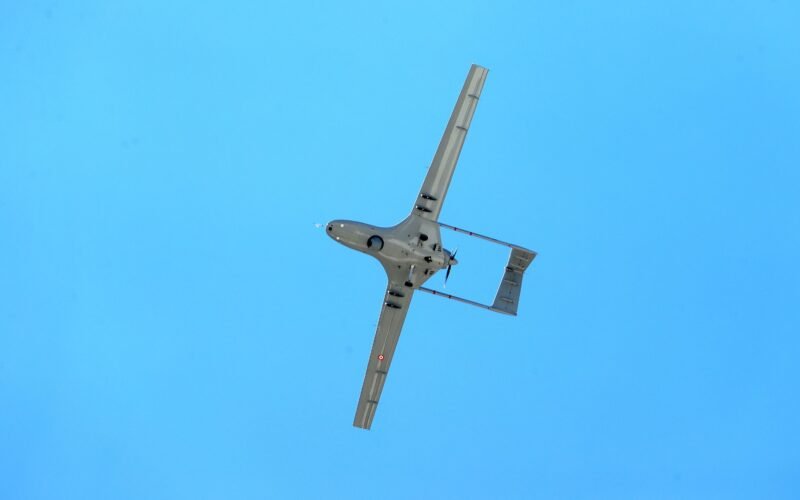
Ukraine says its drones struck two Russian oil refineries and an oil pumping station during the night of 22–23 November, in a wave of long-range attacks reported on 24 November. The targets named in the reports were the Novoshakhtinsk oil refinery in Russia’s Rostov region, the Lukoil refinery in Perm, and the Kaleykino oil pumping station near Almetyevsk in Tatarstan. The Novoshakhtinsk plant suspended work after a raid lasting more than six hours, Rostov Governor Yury Slyusar said — the one part of the account confirmed by a Russian official. Everything about the damage to the plants themselves rests on Ukraine’s account, and it has not been independently verified, according to NewsUkraine, which reported the General Staff’s statement.
Ukraine’s General Staff said its forces struck the Novoshakhtinsk refinery during the night of 23 November, that explosions were heard on the premises, and that a fire broke out “visible even from space”. The statement said the facility sustained damage to its bitumen unit, a primary oil processing unit known as an AVT, a reboiler furnace and a tank farm. It also said a Pole-21 electronic warfare complex and a Pantsir anti-aircraft missile and gun system were hit. The General Staff said the refinery has an annual processing capacity of up to 7.5 million tonnes of oil and produces diesel fuel, marine fuel and fuel oil. The plant sits just tens of kilometres from the Ukrainian border, giving it what NewsUkraine described as a direct and short supply route for fuel to Russian forces operating in the southern direction.
The Perm refinery was struck the same night, according to the Bloomberg tally reported by WiseVoter, which recorded two plants struck on 23 November, including Lukoil’s Perm refinery. The Kaleykino pumping station was also hit that night: four storage tanks were struck, in what WiseVoter reported was the second strike on the site in five days. The three targets, hit in a single night, are part of a wider campaign: Bloomberg counts 15 Russian refineries that Ukraine attacked in November, and the plants in that tally hold more than half of Russia’s refining capacity. This article attributes every damage claim to its source and flags what is confirmed, what is claimed, and what is still unknown.
What Ukraine’s General Staff Says Happened
The fullest account of the night comes from Ukraine’s General Staff, as reported by NewsUkraine. “During the night of November 23rd, the Defense Forces of Ukraine struck the Novoshakhtinsk oil refinery in the Rostov region. Explosions were heard on the premises, and a fire broke out, visible even from space,” the statement read. The General Staff listed the damage as a bitumen unit, a primary oil processing unit, a reboiler furnace and a tank farm. It added: “In addition, the Pole-21 electronic warfare complex and the Pantsir anti-aircraft missile and gun system were hit.” None of that damage has been independently verified, and the statement is the only public source for the unit-level detail at Novoshakhtinsk.
The mention of the Pole-21 and the Pantsir matters, because it is a claim about more than the refinery itself. The Pole-21 is an electronic warfare complex and the Pantsir is an anti-aircraft missile and gun system — the kind of equipment that would be expected to defend a refinery against exactly this kind of attack. If both were hit, as the General Staff claims, the strike would have degraded the site’s defences as well as its processing equipment. But that, too, rests entirely on Kyiv’s account: no Russian official statement confirmed damage to either system, and no independent imagery of the site had been published by the time the reports were filed.
The timing is worth stating plainly, because the reports landed a day after the events. The strikes happened during the night of 22–23 November and were reported on 24 November. They were not 24 November strikes, and the distinction matters for anyone tracking the campaign day by day. The same night also saw Russia fire 96 drones at Ukraine and a Russian drone briefly enter Polish airspace — separate events covered in our other reports — which underlines how busy that single night was on both sides of the war.
Novoshakhtinsk: The Plant That Stopped Work

Novoshakhtinsk is the refinery about which the most is known, because a Russian official confirmed part of the story. Rostov Governor Yury Slyusar said the plant suspended work after a raid lasting more than six hours, WiseVoter reported. That suspension is the one concrete, officially confirmed consequence of the night’s strikes: a refinery stopped operating. The governor did not confirm the General Staff’s account of which units were damaged, and the extent of the damage to the plant remains a Ukrainian claim.
The plant’s profile explains why it would be a target. According to the General Staff, as reported by NewsUkraine, the Novoshakhtinsk refinery has an annual processing capacity of up to 7.5 million tonnes of oil and produces diesel fuel, marine fuel and fuel oil — the fuels that keep vehicles, ships and generators running. The refinery is situated just tens of kilometres from the Ukrainian border, giving it a direct and short supply route for fuel to Russian forces operating in the southern direction. A refinery that close to the front, supplying fuel to forces in the south, is an obvious target for a long-range drone campaign aimed at Russian logistics.
The six-hour duration of the raid, as described by Governor Slyusar, is also significant. A raid lasting more than six hours is not a single drone slipping through; it suggests a sustained attack, with drones arriving over an extended period, and air defences engaged for hours. The General Staff’s claim that a Pole-21 electronic warfare complex and a Pantsir system were hit fits that picture — a longer attack gives defenders more chances to respond, and also gives attackers more chances to find and hit the defences themselves. Whether that is what happened cannot be confirmed from the public record, but the governor’s account of a long raid is consistent with a substantial operation rather than a brief probe.
Perm: Lukoil’s Plant Hit the Same Night
The second refinery hit that night was Lukoil’s plant in Perm, according to the Bloomberg tally reported by WiseVoter. The tally recorded two plants struck on 23 November, including Lukoil’s Perm refinery, and counted Perm among the 15 Russian refineries Ukraine attacked in November. Beyond that, the public record is thin: the sources available for this report do not give unit-level damage for the Perm plant, and no Russian official statement about the Perm strike was quoted in them. That gap is worth stating openly rather than filling in — the Perm strike is confirmed as an event, but its consequences are not yet documented in the sources we could verify.
What the Perm strike does show, even without damage detail, is the breadth of the campaign. Two refineries in different regions, struck on the same night, alongside a pumping station in a third region, point to a coordinated wave rather than isolated attacks. The pattern matches the wider picture in the Bloomberg tally: 15 refineries hit in a single month, holding more than half of Russia’s refining capacity between them. A campaign that can reach plants across Russia on the same night is a different proposition from a campaign that hits one plant at a time, and it is the pattern that energy analysts and military observers will be watching most closely in the weeks ahead.
For readers following the long-range drone war, the Perm strike also fits a familiar trajectory. Ukraine’s drone campaign against Russian energy infrastructure has run all year, and the methods have kept evolving — longer range, larger waves, and targets chosen for their place in the fuel supply chain rather than their proximity to the front. The same evolution is visible in the maritime campaign, including the suspected drone strike on the Sparta II in the Gulf of Finland and Ukraine’s relay-drone attack on the Kerch Bridge, where relay drones were used to bypass Russian defences. The refinery strikes are the land-based counterpart: drones reaching deep into Russia to hit the infrastructure that supplies the war.
Kaleykino: A Second Strike in Five Days


The third target of the night was the Kaleykino oil pumping station near Almetyevsk in Tatarstan, where four storage tanks were hit, according to WiseVoter. It was the second strike on the site in five days — a detail that says something about both the target and the campaign. A pumping station that is hit twice in less than a week is either a target Ukraine considers important enough to return to, or a target whose defences have not been reinforced after the first hit, or both. Either way, the repeat strike is a sign that the campaign is not a series of one-off attacks but a sustained effort against the same infrastructure.
Pumping stations are less visible than refineries, but they are a critical link in the chain. A refinery turns crude oil into fuel; a pumping station moves the crude oil to the refinery and the products onward. Hitting storage tanks at a pumping station disrupts the flow of oil itself, and four tanks hit in one night is a substantial blow to a single site. The Kaleykino strike, coming the same night as the two refinery strikes, also shows the campaign’s range of targets: not just the plants that refine the fuel, but the infrastructure that moves it.
The five-day gap between the two Kaleykino strikes is worth noting for another reason. It suggests that Ukraine is revisiting targets quickly, before repairs are complete — a pattern that puts pressure on Russian repair crews and on the air defences around energy sites. If a site is hit, repaired, and hit again within days, the cost of defending it rises and the value of the repair falls. That is the logic of a campaign of attrition, and it is the same logic that runs through the refinery tally as a whole.
Fifteen Refineries in November: The Wider Campaign
The three strikes of 22–23 November sit inside a much larger November. Bloomberg counts 15 Russian refineries that Ukraine attacked in the month, after the 23 November strikes, according to WiseVoter. The 15 refineries hold more than half of Russia’s refining capacity, so the campaign is not nibbling at the edges of the industry — it is hitting the core of it. Russian refineries processed about 2.7 million barrels a day on 17 November, WiseVoter reported, drawing on the same tally, against a full working capacity of 5.5 million barrels a day. In other words, Russian refining throughput was running at roughly half of what the country’s plants can do.
The gasoline picture is just as stark. Gasoline output on 17 November was roughly 60 to 65 percent of what the market took in past Novembers, according to WiseVoter. That is a measure of what ordinary Russians are feeling at the pump, not just what the military is feeling at the front. The Ryazan refinery lost about 90 percent of its capacity after burning earlier in the month, and the restart timeline for the damaged plants remains unclear. Russian refinery throughput of about 2.7 million barrels a day on 17 November also sits below the 3.3 million barrel-a-day low reached in early July, extending a downward trend in Russian refining output.
Those numbers come with a caveat that applies to the whole tally: they are drawn from Bloomberg’s count and from throughput estimates, not from official Russian figures, and the restart timeline for the damaged plants is unknown. But the direction of travel is clear, and it is the direction that matters for the war. A refining industry running at roughly half capacity, with gasoline output down by a third or more, cannot supply both the domestic market and the military at normal levels. Something has to give — and in a war economy, what gives is usually the civilian market first, and then the military’s fuel supply.
The campaign’s effect on the war itself is harder to measure, and the sources do not claim to measure it. What they show is a sustained, month-long effort against a defined set of targets, with the same plants hit repeatedly and the throughput numbers falling through November. That is the pattern of a campaign designed to degrade an industry over time, not to produce a single dramatic result. The 22–23 November strikes are best understood as the latest wave in that campaign, not as a standalone event.
What This Means for Drone Pilots and the Industry


For civilian drone pilots, the refinery strikes are not a flying lesson — they are a reminder of how far long-range drone technology has travelled, and how quickly it has become a strategic weapon. The drones in this story are military long-range systems, not the quadcopters most readers fly, but the underlying trend is the same one that shapes the civilian market: longer range, greater autonomy, and the ability to operate far from the operator. The same advances that let a drone reach a refinery hundreds of kilometres away are driving the development of long-endurance military drone systems and, in the civilian world, longer-range survey and inspection aircraft.
For the drone industry, the story underlines a second trend: the spread of drone warfare to infrastructure. Refineries, pumping stations and ports are now targets, and the defences that failed at Novoshakhtinsk — whatever they were — will be studied by every operator of critical infrastructure. The Pole-21 and Pantsir systems that Ukraine claims to have hit are the kind of equipment that protects high-value sites, and if they can be defeated by drones, then every refinery, port and power station has to rethink its defences. That has direct implications for the counter-drone market, which is growing fast as governments and companies look for ways to protect fixed sites against uncrewed attack.
For buyers and operators of long-range drones, the practical takeaway is narrower. The campaign shows what long-range, one-way drones can do against fixed infrastructure — and it shows the limits of the defences built to stop them. The same lesson runs through the wider story of drone warfare in 2026, from Russia’s Lancet drones in Mali to the maritime strikes in the Baltic and the Mediterranean. Drones are no longer a niche capability for reconnaissance; they are the primary long-range strike weapon of this war, and the refinery campaign is the clearest evidence of that shift.
None of this should be overstated. The refinery strikes are, at their core, a Ukrainian claim supported in one case by a Russian governor’s confirmation that a plant stopped work — but the full extent of the damage has not been independently verified. The drone industry should watch the verification, not just the claim: independent confirmation of the damage at Novoshakhtinsk and Perm, and of the throughput figures, would tell us far more about the state of the campaign than the headline alone.
What to watch next. The first thing to watch is whether the Novoshakhtinsk plant restarts, and how long it stays down — Governor Slyusar confirmed the suspension, and the restart date will say more about the damage than any claim. The second is whether independent imagery or reporting confirms the damage at Perm, where the public record is still thin. The third is the November throughput figures: whether refining output recovers from the 2.7 million barrels a day recorded on 17 November, or keeps falling as more plants are hit. The fourth is whether Kaleykino is hit a third time, which would confirm the pattern of rapid repeat strikes. And the fifth is the next wave itself: whether the campaign keeps hitting refineries at the pace of November, and whether Russian air defences around energy sites are reinforced in response.
Frequently Asked Questions
Which refineries were struck on the night of 22–23 November? Ukraine’s General Staff said its forces struck the Novoshakhtinsk oil refinery in Russia’s Rostov region and Lukoil’s Perm refinery, and WiseVoter reported that the Kaleykino oil pumping station near Almetyevsk in Tatarstan was also hit that night. The Novoshakhtinsk strike is the best documented: the General Staff described explosions, a fire visible even from space, and damage to a bitumen unit, a primary oil processing unit, a reboiler furnace and a tank farm.
How much damage was done to the refineries? That is not independently verified. The damage claims come from Ukraine’s General Staff, which said the Novoshakhtinsk plant suffered damage to its bitumen unit, a primary oil processing unit, a reboiler furnace and a tank farm, and that a Pole-21 electronic warfare complex and a Pantsir air-defence system were hit. The one officially confirmed consequence is that the Novoshakhtinsk plant suspended work after a raid lasting more than six hours, according to Rostov Governor Yury Slyusar. No damage figures for the Perm plant were available in the sources for this report.
Why is the Novoshakhtinsk refinery significant? According to Ukraine’s General Staff, as reported by NewsUkraine, the plant has an annual processing capacity of up to 7.5 million tonnes of oil and produces diesel fuel, marine fuel and fuel oil. It sits just tens of kilometres from the Ukrainian border, giving it a direct and short supply route for fuel to Russian forces operating in the southern direction. A refinery that close to the front, supplying fuel to forces in the south, is an obvious target for a long-range drone campaign aimed at Russian logistics.
How many Russian refineries has Ukraine hit in November? Bloomberg counts 15 Russian refineries that Ukraine attacked in November, after the 23 November strikes, according to WiseVoter. The 15 refineries hold more than half of Russia’s refining capacity. Russian refineries processed about 2.7 million barrels a day on 17 November, against a full working capacity of 5.5 million barrels a day, and gasoline output on 17 November was roughly 60 to 65 percent of what the market took in past Novembers.
Was the Kaleykino pumping station hit before? Yes. WiseVoter reported that the strike on the Kaleykino oil pumping station, in which four storage tanks were hit, was the second strike on the site in five days. The repeat strike suggests Ukraine is revisiting targets quickly, before repairs are complete, which puts pressure on Russian repair crews and on the air defences around energy sites.
Join Our Pilot Community
Connect with fellow drone enthusiasts, share your aerial shots, and get access to free PDF ebook guides.