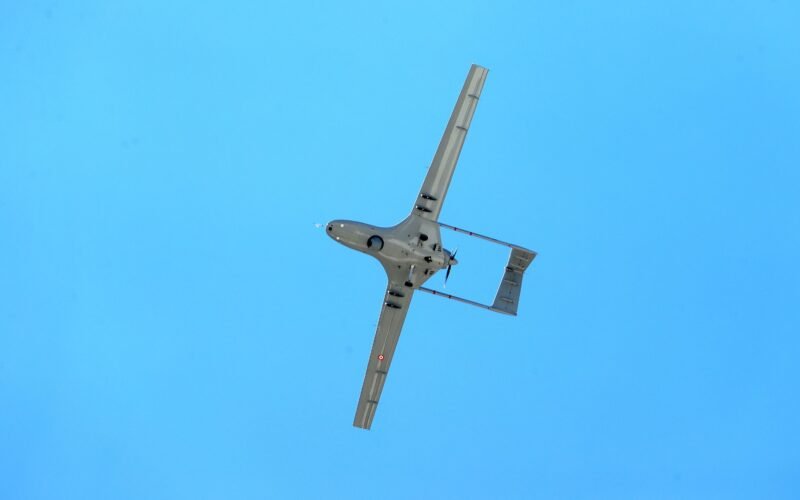
A five-Marine team from Britain’s Royal Marines has won the first International Drone Crucible, a special operations drone competition held at Grafenwöhr Training Area in Germany, beating teams of US Army Green Berets, Naval Special Warfare operators and Air Force special tactics airmen, as well as teams from Germany, Latvia and Ukraine. The winning team came from the Information Warfare Company of 40 Commando, based in Taunton, and took top honours after 400 sorties across three challenges, according to the Royal Navy, which announced the result on 17 November. US Special Operations Command Europe (SOCEUR), which hosted the event, published its own account on 23 November, six days later. The result is a notable one: a small team of Royal Marines, with what their commander described as “minimal preparation time as a team”, finished ahead of some of the most experienced special operations drone pilots in the world, according to DroneXL.
The win is also a story about how fast drone flying is being learned outside the special operations community. The Royal Marines team is not part of UK Special Forces. Its members came from different specialities within the Information Warfare Company, and they had little time together as a team before the competition. Yet they beat operators who fly drones for a living, in an event designed to test the hardest parts of military drone flying: long-range strikes, flying through buildings, and coordinating multiple drones on a single target. That is the lesson the organisers themselves drew from the event, and it is the lesson that matters most for anyone who flies drones, military or civilian.
One caution before the detail. The two official accounts of this event do not agree with each other. SOCEUR credits Royal Marines “40th and 45th Commando teams” and calls the event weeklong, running from 2 to 5 November. The Royal Navy describes one five-person team from 40 Commando and a three-day event, and names the United States National Drone Association (USNDA), not SOCEUR, as the host. Neither account publishes scores, says who won which challenge, or names the drones the teams flew. This article reports both accounts, notes where they differ, and does not invent the details that neither side published.
The First International Drone Crucible
SOCEUR hosted its first International Drone Crucible at Grafenwöhr Training Area in Germany from 2 to 5 November 2026, according to DroneXL, reporting SOCEUR’s account and the Royal Navy’s announcement. The event was run with the United States National Drone Association (USNDA), and SOCEUR published its account on 23 November. The Royal Navy had announced the result six days earlier, on 17 November. The competition was the first of its kind: a special operations drone contest that brought together teams from five nations to fly against each other in realistic lanes, rather than in a classroom or on a simulator.
The American side came from three services: the Army’s 1st Battalion, 10th Special Forces Group (Airborne) — the Green Berets — Naval Special Warfare operators, and the Air Force’s 321st Special Tactics Squadron. US Army operators also flew on a joint team with Latvian special operators. Germany sent the Bundeswehr’s 270th Airborne Engineer Company, and Ukraine sent a special operations team. The Royal Navy says teams from five nations competed, and the Royal Marines beat all of them.
The event follows another drone competition at the same training area. US Army Europe and Africa ran its first Best Drone Warfighter Competition at Grafenwöhr in December 2025, and a week after the Crucible the Army launched swarm drones from an unmanned ground vehicle at the same training area. Grafenwöhr is becoming a centre for military drone competition in Europe, and the Crucible is the most ambitious event held there so far. The Army Drone Team has also listed an earlier drone crucible, at Avon Park in Florida, among its first events — so the format itself is not new, but the international, special-operations version of it is.
Five Marines from 40 Commando


The winning team is not part of UK Special Forces. The Royal Navy says the five Marines belong to the Information Warfare Company of 40 Commando, based in Taunton. Major William Docherty, who commands the company, said his Marines came from different specialities and had “minimal preparation time as a team”. He said they did well against experienced pilots from the special operations community. The Royal Navy’s account adds that the team was commended by the hosts, the US National Drone Association, for “outstanding performance, professionalism and dedication”.
That description matters because it tells us what kind of team won. The Information Warfare Company brings together sensors, communicators and strike options to solve operational problems, according to Docherty. “IW Company brings together sensors, communicators and strike options to solve operational problems; so when a new capability like FPV (First Person View) strike emerges, our Marines are perfectly placed to understand how it can be employed and integrated,” he said. The team was not a specialist drone unit. It was a group of Marines from different jobs, brought together to learn a new capability quickly — and they learned it fast enough to beat specialists.
The Royal Navy’s announcement also places the win in a wider context of rapid development. For the Royal Marines and UK Commando Force, the victory reflects the rapid development of drone skillsets and the long-term work ongoing for a credible First-Person View drone strike capability. It was also a chance for industry partners to present their newest kit and understanding to better the needs of the user on the battlefield. The competition was not just a contest between teams; it was also a showcase for the equipment and the training methods that are shaping how allied forces fly drones.
The Three Challenges
The Crucible was built around three challenges, each testing a different part of military drone flying. The first was a long-range strike. Teams had to locate a target more than 1.2 miles (2 kilometres) away, confirm it with a surveillance drone, hit it, and then fly a battle damage assessment. The Royal Navy’s account describes the same challenge: locating a target from more than two kilometres away, confirming a positive identification with a surveillance drone before striking the target and conducting a battle damage assessment. That is a full kill chain in miniature — find, confirm, strike, assess — and it tests the whole team, not just the pilot.
The second challenge sent drones into and through two-storey buildings and narrow spaces. Teams were tasked with clearing buildings, flying their drones into and through two-storey buildings and narrow spaces, in the Royal Navy’s words. This is close-quarters drone flying: the kind of work that demands precise control, good depth perception through a first-person-view feed, and the ability to keep flying when the signal degrades inside a building. It is also the kind of flying that civilian FPV pilots practise every day, which is part of why the result is interesting beyond the military.
The third challenge tested coordination. Each team had to put three drones on a single target, in order and in quick succession. The Royal Navy describes the final challenge as coordinating strikes, concentrating three drones on one target, in order, in quick succession, with teams clearing the urban site and coordinating a strike. That is a harder test than it sounds: three drones, three pilots, one target, and the timing has to be right. It tests communication and teamwork as much as flying skill, and it is the closest the competition came to testing a swarm — the subject of our guide to drone swarm military technology.
Each of the three challenges had a different winner, according to the Royal Navy, but the UK team was crowned champion for its strong overall display. The title came after 400 sorties, against teams from the United States, Germany, Latvia and Ukraine. That is the key detail: the Royal Marines did not sweep the competition. They won the overall title by being consistently strong across all three challenges, while other teams won individual challenges. Which team won which challenge has not been published, and neither account names the drones the teams flew.
The Lanes: Forest, Open Ground and Degraded Signals

SOCEUR’s account adds detail about the conditions the teams flew in. The lanes ran through dense forest and open ground, and teams flew against signal degradation, limited visibility and obstacles. No lane fixed a flight path, so each team flew its own way. Alongside the head-to-head lanes, SOCEUR says, the event focused heavily on shared range work and interoperability. That last point matters: the competition was not only about who won, but about getting allied operators to fly together, share techniques, and learn how each other’s systems work.
The conditions described — signal degradation, limited visibility, obstacles, no fixed flight path — are the conditions that make military drone flying hard, and they are also the conditions that separate a good pilot from a lucky one. A fixed flight path can be memorised. A lane through dense forest, with the signal dropping in and out, cannot. The pilot has to read the terrain, manage the link, and keep the drone flying when the picture breaks up. That is the skill the Crucible was testing, and it is the skill the Royal Marines team showed most consistently.
The same conditions apply, in a different form, to civilian flying. Signal degradation, limited visibility and obstacles are the everyday problems of any pilot who flies beyond line of sight, in forests, or in built-up areas. The difference is that a civilian pilot who loses the link can usually bring the drone home, while a military pilot who loses it in a building or a forest may lose the aircraft. The Crucible’s lanes were designed to test the harder version of the problem, and the lessons — about link management, about flying without a fixed path, about working as a team — apply to both worlds.
Two Accounts That Do Not Agree
The two official accounts of this event differ in ways that readers should know about. SOCEUR credits Royal Marines “40th and 45th Commando teams” and calls the November 2 to 5 event weeklong. The Royal Navy describes one five-person team from 40 Commando and a three-day event. The Royal Navy also names USNDA, not SOCEUR, as the host. SOCEUR’s own photo captions date the close-quarters lane to November 3 and a plaque presentation to November 5. Neither account publishes scores, says who won which challenge, or names the drones the teams flew.
These are not trivial differences. The team description matters because it changes the story: one five-person team from a single commando unit is a different achievement from two teams drawn from two units. The event length matters because a three-day event and a weeklong event are different commitments. And the host matters because it tells us who organised the competition and who set the rules. None of these differences changes the result — both accounts agree the Royal Marines won — but they do mean that the details of the event are not yet settled, and that any article which states them as fact without noting the discrepancy would be misleading.
The discrepancy is also a reminder of how military reporting works. SOCEUR published its account on 23 November, six days after the Royal Navy’s announcement on 17 November, and the two organisations describe the same event from different perspectives, with different details. That is normal. What matters is that readers know the accounts differ, and that the scores, the challenge winners and the drone models have not been published by either side. This article does not invent them, and neither should any other.
What the Result Means for Drone Flying

SOCEUR does say what happens to the numbers. Performance data from the lanes will be used to update and standardize joint special operations tactics for small drones. Master Sergeant Raymond Rivera, the senior enlisted leader of SOCEUR’s Theater Edge Innovation Lab, said the competition makes troops “think critically, solve problems under pressure”. That is the official purpose of the event: not to crown a winner, but to generate data that will change how allied special operations forces fly small drones. The Royal Marines’ win is the headline, but the data is the product.
For civilian drone pilots, the lesson is about how fast FPV skill can be learned. Five Marines from an information warfare company, with little time together, finished ahead of experienced special operations pilots, and that tells us FPV skill is learned fast by people who put in the hours. The same lesson applies to anyone learning to fly: the gap between a beginner and an expert is not as wide as it looks, and it closes faster than most people expect. The Royal Marines team did not have better equipment — the drones were not named, and there is no suggestion they had superior aircraft. They had better teamwork, better adaptation, and better flying under pressure.
The Crucible is one part of a wider allied effort to build drone capability for Ukraine, which includes Sweden’s K200 drone interceptor for Ukraine. For the drone industry, the Crucible is a signal about where military drone development is heading. The challenges — long-range strike, flying through buildings, coordinating multiple drones on a target — are the same capabilities that civilian operators are developing for inspection, search and rescue, and delivery. The competition also shows that the military is learning from civilian FPV flying, not just the other way round: the skills that win a drone race or a freestyle competition are increasingly the skills that win a military drone contest. That convergence is one of the most important trends in the drone world, and it runs through our guides to tactical military drone capabilities and long-endurance military drone systems.
The result also matters for the countries that took part. Ukraine sent a special operations team, and the competition gave its operators a chance to fly alongside NATO allies and share the lessons of a war in which drones have become central. Germany sent the Bundeswehr’s 270th Airborne Engineer Company, and Latvia flew a joint team with US Army operators. The Crucible was, in that sense, as much a training event as a competition — a way for five nations’ drone operators to learn from each other in the same lanes, under the same conditions. The Royal Marines won, but every team that flew went home with more experience than it arrived with.
What to watch next. The first thing to watch is whether SOCEUR or the Royal Navy publishes the scores, the challenge winners or the drone models — none of which has been released, and all of which would tell us much more about what actually happened in the lanes. The second is whether the performance data from the Crucible changes joint special operations tactics for small drones, as SOCEUR says it will, and whether that change is visible in the next competition. The third is the next event at Grafenwöhr: the Best Drone Warfighter Competition in December 2025 and the swarm launch a week after the Crucible suggest the training area is becoming a regular venue, and the next Crucible will show whether the Royal Marines’ win was a one-off or the start of a pattern. And the fourth is the discrepancy itself — whether either side clarifies the team description, the event length or the host, and settles the details of what was, by both accounts, a first-of-its-kind event.
Frequently Asked Questions
Who won the first International Drone Crucible? Britain’s Royal Marines won. The Royal Navy says a five-Marine team from the Information Warfare Company of 40 Commando, based in Taunton, took top honours after 400 sorties, beating teams from the United States, Germany, Latvia and Ukraine. SOCEUR, which hosted the event, published its own account on 23 November, six days after the Royal Navy announced the result.
Who did the Royal Marines beat? The American teams were Army Green Berets from the 1st Battalion, 10th Special Forces Group (Airborne), Naval Special Warfare operators, and Air Force special tactics airmen from the 321st Special Tactics Squadron. Germany sent the Bundeswehr’s 270th Airborne Engineer Company, Latvia flew a joint team with US Army operators, and Ukraine sent a special operations team. Each of the three challenges had a different winner, but the Royal Marines were crowned champions for their overall display.
What were the three challenges? The first was a long-range strike: locate a target more than 1.2 miles (2 km) away, confirm it with a surveillance drone, hit it, then fly a battle damage assessment. The second sent drones into and through two-storey buildings and narrow spaces. The third required each team to put three drones on a single target, in order and in quick succession. The lanes ran through dense forest and open ground, with signal degradation, limited visibility and obstacles, and no lane fixed a flight path.
Why do the two official accounts disagree? SOCEUR credits Royal Marines “40th and 45th Commando teams” and calls the event weeklong, from 2 to 5 November. The Royal Navy describes one five-person team from 40 Commando and a three-day event, and names the US National Drone Association, not SOCEUR, as the host. Both accounts agree the Royal Marines won, but the details differ, and neither publishes scores, challenge winners or drone models.
What happens to the performance data from the competition? SOCEUR says the performance data from the lanes will be used to update and standardize joint special operations tactics for small drones. Master Sergeant Raymond Rivera, the senior enlisted leader of SOCEUR’s Theater Edge Innovation Lab, said the competition makes troops “think critically, solve problems under pressure”. The data, rather than the trophy, is the lasting product of the event — and it is one reason the next competition at Grafenwöhr will be worth watching.
Join Our Pilot Community
Connect with fellow drone enthusiasts, share your aerial shots, and get access to free PDF ebook guides.